MatekVÁR
Making math feel like play for Hungarian children — web and mobile
- EdTech
- Mobile App
- Gamification
Overview
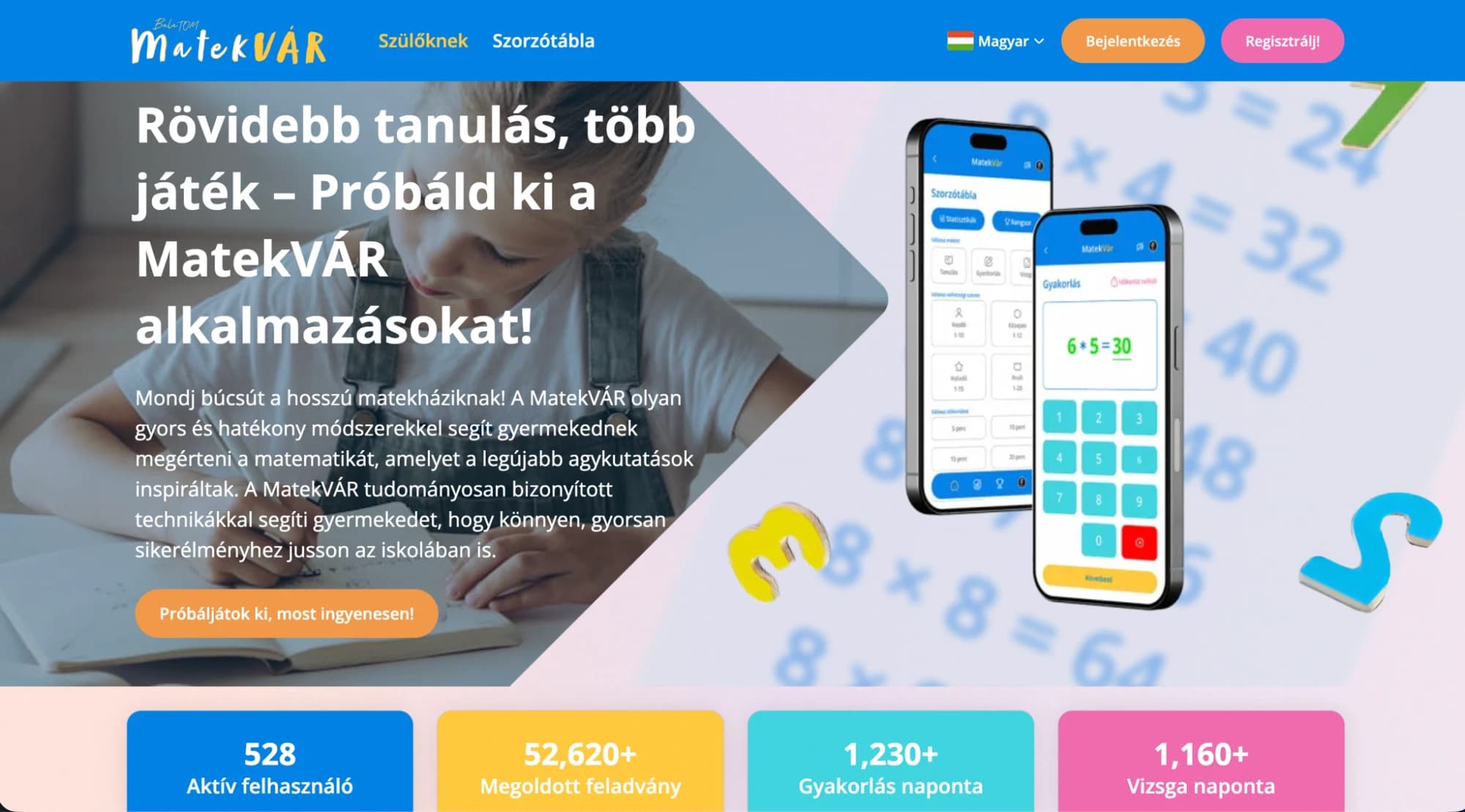
MatekVÁR is a Hungarian educational platform that helps children master mathematics through game-inspired practice. The product serves parents, students, and teachers across unified web and mobile experiences. At launch: 528 active users and 52,620+ solved tasks with strong daily engagement.
The challenge
Educational apps for children face a core tension: the interface must feel fun, rewarding, and immediately understandable for kids while signalling credibility, safety, and educational rigor to parents. The design had to satisfy both audiences through careful hierarchy, visual language, and information architecture.
The solution
Full product design across platforms with an energetic palette (blues, oranges, teals), clear typography, and generous spacing. Core learning flows are structured as self-contained sessions with immediate feedback and progress indicators. Mobile prioritized one-thumb usability with large touch targets and minimal cognitive load per screen.
Outcome
- Dual-audience design: child engagement + parent credibility
- Consistent web + mobile system in Figma
- 1,230+ daily practice sessions, 1,160+ daily exam sessions
- Gamified flows with immediate feedback and completion states
- Live usage metrics integrated into the homepage
User Journey Analysis
Actor: Parent setting up for a 9-year-old
Teacher recommends MatekVÁR at parent-teacher evening
Parent landing page leads with educator endorsements and progress reporting features — not game screenshots
Signs up as parent, creates child's account in under 2 minutes
Separate parent/child account structure: parent controls settings, child plays without admin access
Child starts practice — bright colours, stars, instant feedback after each answer
Session structure: bite-sized 8-minute blocks with a progress reward at the end
Parent checks weekly progress — not sure how to read the numbers
Dashboard redesigned with plain-language summaries alongside raw statistics
Child requests practice time unprompted — asks if they can 'do math'
Daily streak system and achievement badges drive intrinsic motivation without parental prompting
UX Artifacts
Dual-Audience Design Matrix
- Children's needs
- Immediate feedback, visual rewards, low reading load, large touch targets
- Parents' needs
- Progress data, curriculum alignment, session time controls, safety
- Shared requirement
- Reliability — platform cannot fail or freeze mid-session
- Navigation (child)
- Large icons + colour coding — no labels required
- Navigation (parent)
- Data tables, filters, settings — adult information density
Gamification Pattern Audit
- XP / points system
- Present — earned per correct answer, visible in session
- Progress bars
- Present — per session + cumulative curriculum progress
- Daily streaks
- Present — login streak + weekly completion streak
- Achievement badges
- Present — milestone unlocks (50, 100, 500 solved tasks)
- Leaderboard
- Absent — removed after testing revealed sibling rivalry stress
- Difficulty adaptation
- Present — session rebalances after 3 consecutive errors
next frame →
Standup Republic
End-to-end platform for Germany's stand-up comedy scene